

How Did We End Up Here?
How Gender Theology Was Never Fully Christianized, Part 1

Numquam Reformanda: “Never Being Reformed.”1
The path of this post has been well trodden, and probably done better (or at least more thoroughly!) by many.23456
But in order to understand Representationalism, we first have to understand the struggle for women to be viewed as equal in their essence, or “ontology”, to men, which involves conversations around men and women as “imago Dei”, or the image of God.
For almost all of her history, the church never challenged the pre-Christian view of a lower ontology of women, making gender theology truly a “never reformed” space. Women were included as images of God indirectly, or through abstracted human qualities like intellect, but never as robustly as men.
This post highlights how a sub-Christian understanding of gender flowed like a river from the Greco-Roman world through the church fathers, Augustine, the medieval period, the Reformers, and is still in the waters today.
A Quick Tour
Deformed anthropology from the Greco-Roman world into the Church Fathers
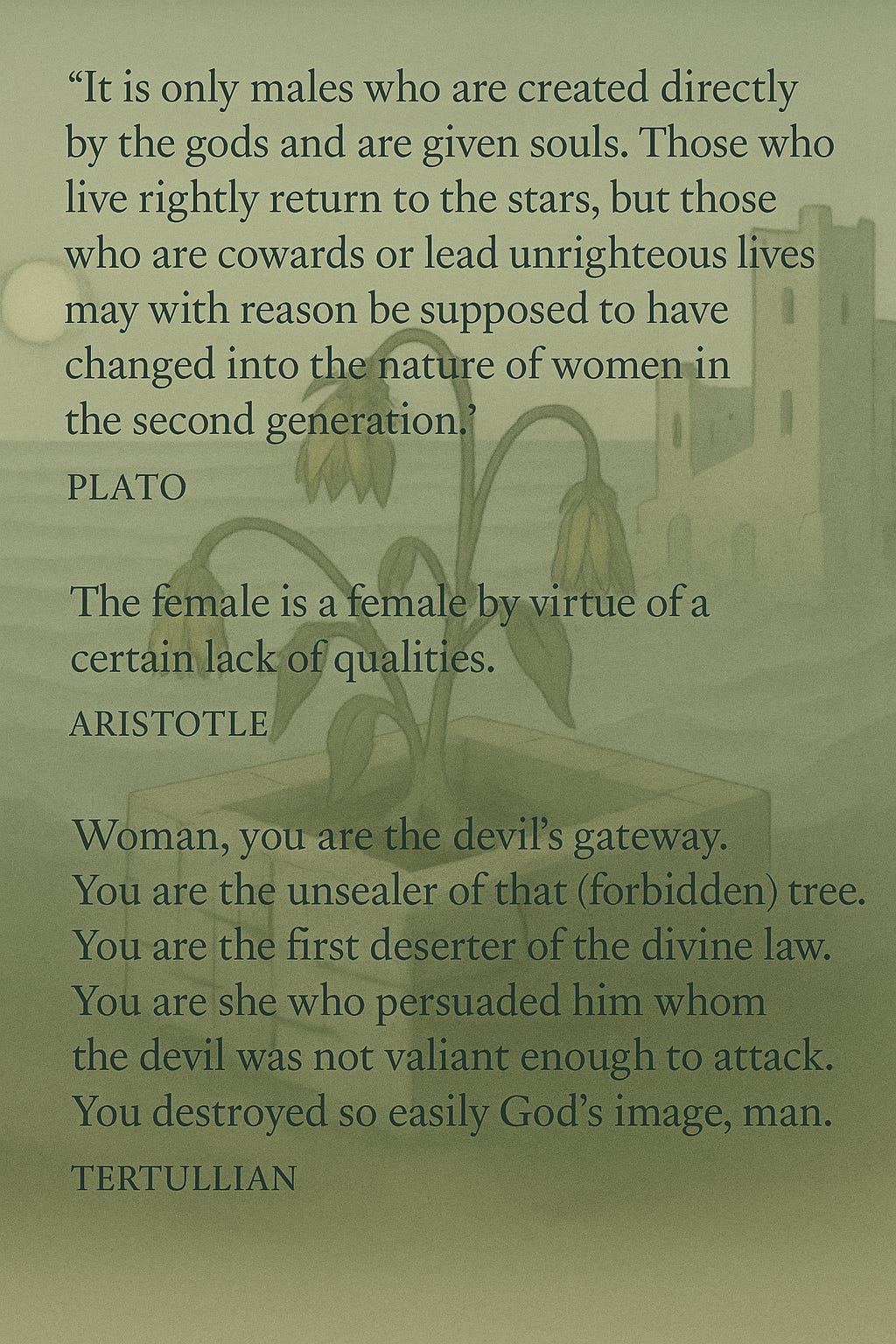
The basic premise of women as “less than and derivative of” men was the common conceptual framework of the Greco-Roman world for hundreds of years. Unfortunately, these ideas crept into the early church, and particularly into the works of the massively influential St. Augustine, cementing the idea that women were not as full of an expression of the image of God as men.
Augustine saw men and women as both image bearers in their cognition, but in their bodies and essence, he saw women in their embodiment as representing the “lower faculties” of our humanity that need to be ruled by our higher faculties, represented by men.
For Augustine, the secondary creation of Eve meant that women are not fully imago Dei on their own, but only in concert with men. Men, however, fully imaged God alone.7
Thomas Aquinas agreed; here’s a sample quote:8
“God’s image is found in man in a way in which it is not found in woman; for man is the beginning and end of woman, just as God is the beginning and end of all creation.”
Surely the Reformers were different?
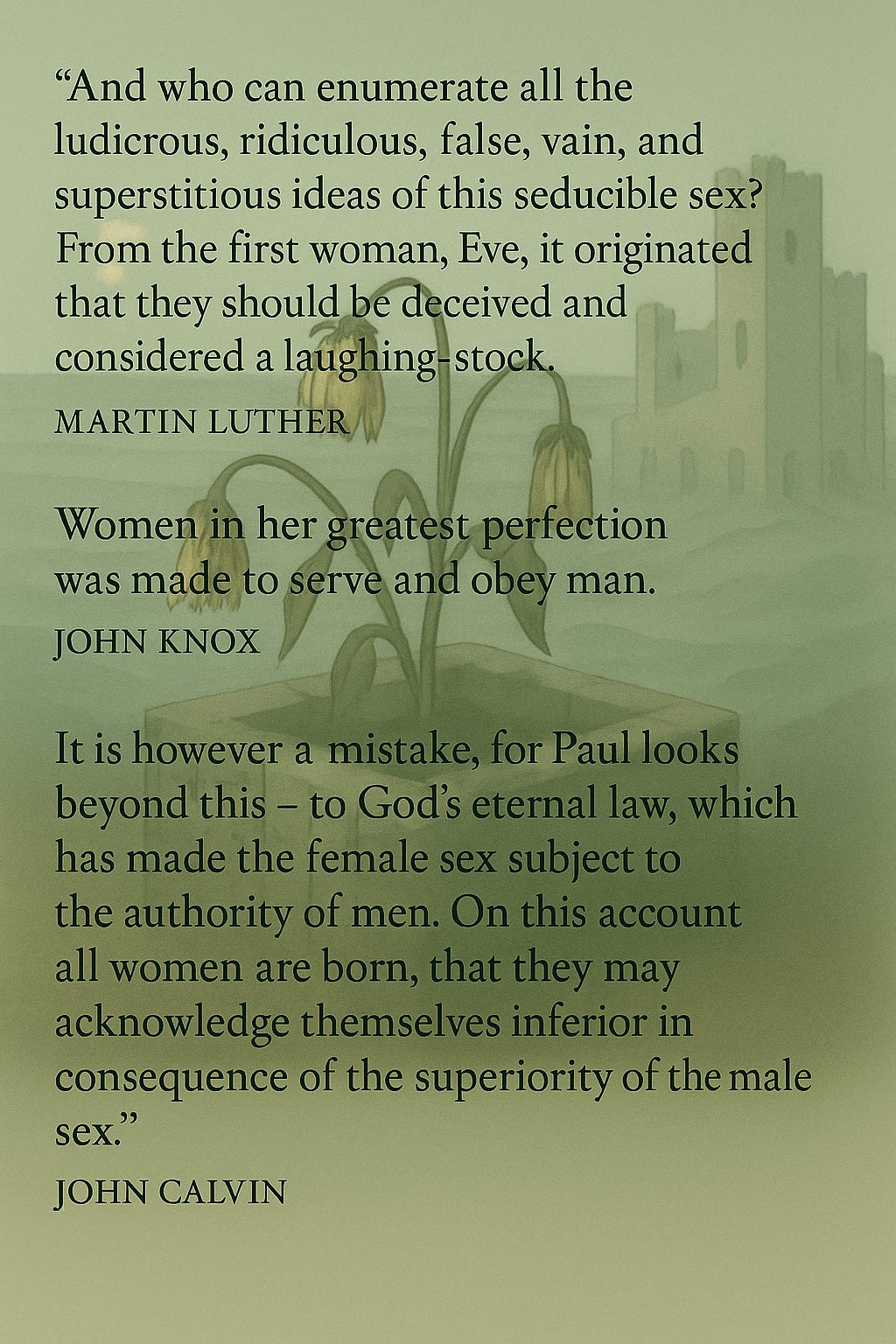
This view carried forward up to and through the Reformation relatively unscathed. While men and women were to be considered imago Dei, women were viewed as derivative of men and an extension of him, ruled by necessity of their weaker frame and intellect.
Here’s another quote from Calvin:9
“Moses teaches that women are created to be a kind of appendage to the man on the express condition that woman should be ready to obey him. Thus, God did not create two ‘beings’ of equal standing, but added to man a lesser helpmeet.”
Ok but that was hundreds of years ago!
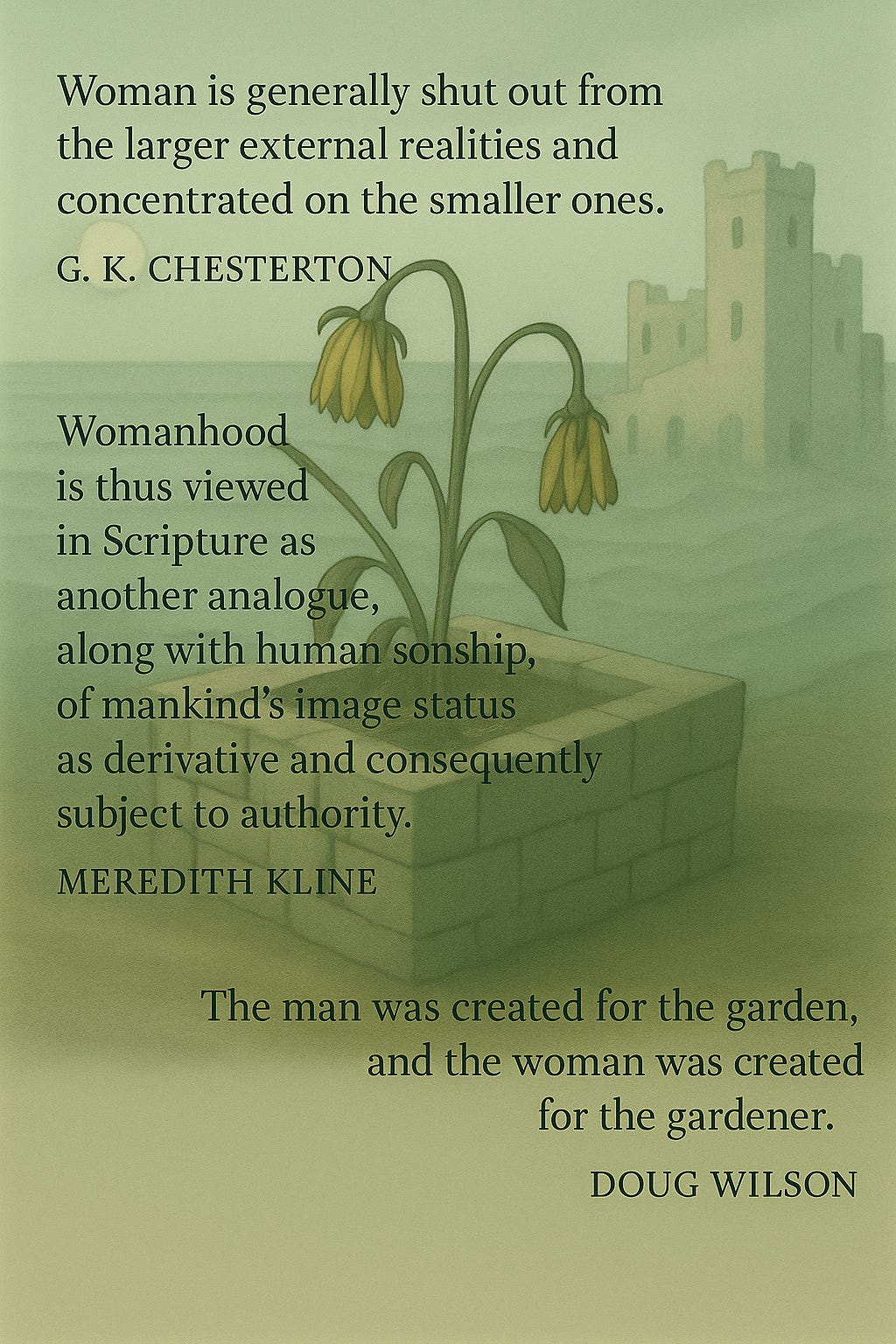
At this point, the reader will perhaps be unsurprised to learn that this view continued relatively unabated10 until the feminist movements of the 20th century. The challenge and critiques of 1st and 2nd wave feminism demanded a response from evangelical Christianity, and the path divided into three ways forward.
One path was to double down, ignore the feminist critiques, and continue in the tradition of what is often called Christian Patriarchy. Here women remain derivative of men, and are not thought to uniquely image God.
The 2nd path was to embrace the feminist movements and their implications, and to pivot completely away from the (clearly tainted) tradition. This is the origin of Christian Egalitarianism of various shades.
The 3rd path was to make some concessions to feminist insights and corrections to the misogynistic tradition, clean up the narrative a bit, and include women as fully imago Dei yet with different “roles” than men. This was the origin of Complementarianism, which started in 1987 with the “Danvers Statement”.11
The next post will finish the journey by telling the story of Complementarianism as a flawed (though improved) paradigm, which still comes up short of a fully reformed Christian anthropology, so stay tuned!
But before we end, here’s a quick closing thought:
In the Beginning
“The second time you read through Scripture is the first time you understand it.”
As we conclude, let’s do a thought experiment.
Imagine a person who knew very little about Christianity reads the Bible straight through from cover to cover. They finish encouraged but quite perplexed (so many names!), and so they decide to get a crash course on Christian theology and take another stab at it.
What might they understand, with their newfound intuitions, on their second journey through Genesis?
They’ve learned that God exists as three persons with one divine nature, in a “divine community” of difference and equality.
So, when they read God say, “let us make mankind in our image” in Genesis 1, they would understand that creating his image might involve creating more than one person, and that they would be ordered, but different. And they would assume, but perhaps not know how to fully explain, that men and women equally image God, but in different ways.
They’ve learned that God really likes foreshadowing, typology, and symbolism.
And so, they know that these early chapters of Genesis will be chock-full of meaning and motifs that are continued and expanded throughout the story of Scripture. They have seen some of them, but are primed to see even more as they work back through the text.
And, if they were especially astute readers, they might have noticed that the story of humanity begins with a man (Adam), but ends with a woman (The Bride of Revelation 21), and is fundamentally a story of heaven and earth coming together12 through the work of the Son and the Spirit.13
In other words, perhaps if they didn’t have all the baggage, they might anticipate something like… Representationalism!? One can hope.
We’ll continue to build the case in the next post. Until then, make sure you subscribe so you don’t miss it!
https://religionnews.com/2024/03/11/scholar-dr-daniel-b-wallace-shares-insights-on-first-female-president-of-the-evangelical-theological-society/
Aimee Byrd has a nice summary in chapter 1 of “The Sexual Reformation” with many of the same quotes, as well as lots of adjacent material in “Recovering From Biblical Manhood and Womanhood”.
Beth Allison Barr’s book “The Making of Biblical Womanhood” has tons of examples also, though perhaps different conclusions!

Gregg Allison’s new tome “Complementarity” traces at length the views of men and women in Western thought and is a great resource in that regard!
Here I will include all the caveating and throat clearings: I’m not an expert on this topic, this is how I understand things but could be missing something, etc. etc. :0)
Allison, “Complementarity”, pgs. 47-52
Allison, “Complementarity”, pg. 62
Allison, “Complementarity”, pg. 98
Yet with plenty of exceptions! https://ifl.web.baylor.edu/sites/g/files/ecbvkj771/files/2024-03/WomenandtheChurchArticleBrekus.pdf
https://cbmw.org/about/the-danvers-statement/
https://thinktheology.co.uk/blog/article/beautiful_difference_the_complementarity_of_male_and_female
https://www.crossway.org/articles/the-work-of-the-son-and-spirit/
John, I’m really intrigued by what you’re putting forward here. Looking forward to reading it and engaging with the ideas Thanks for doing the work!
Thanks for the post, John!
The talk of classical sources has me wondering how the Genesis gender creation narrative would have been prophetic in ANE gender ideologies. For example, does the being drawn from the side of the man denote an equality other creation stories didn't? Any resources you can suggest?